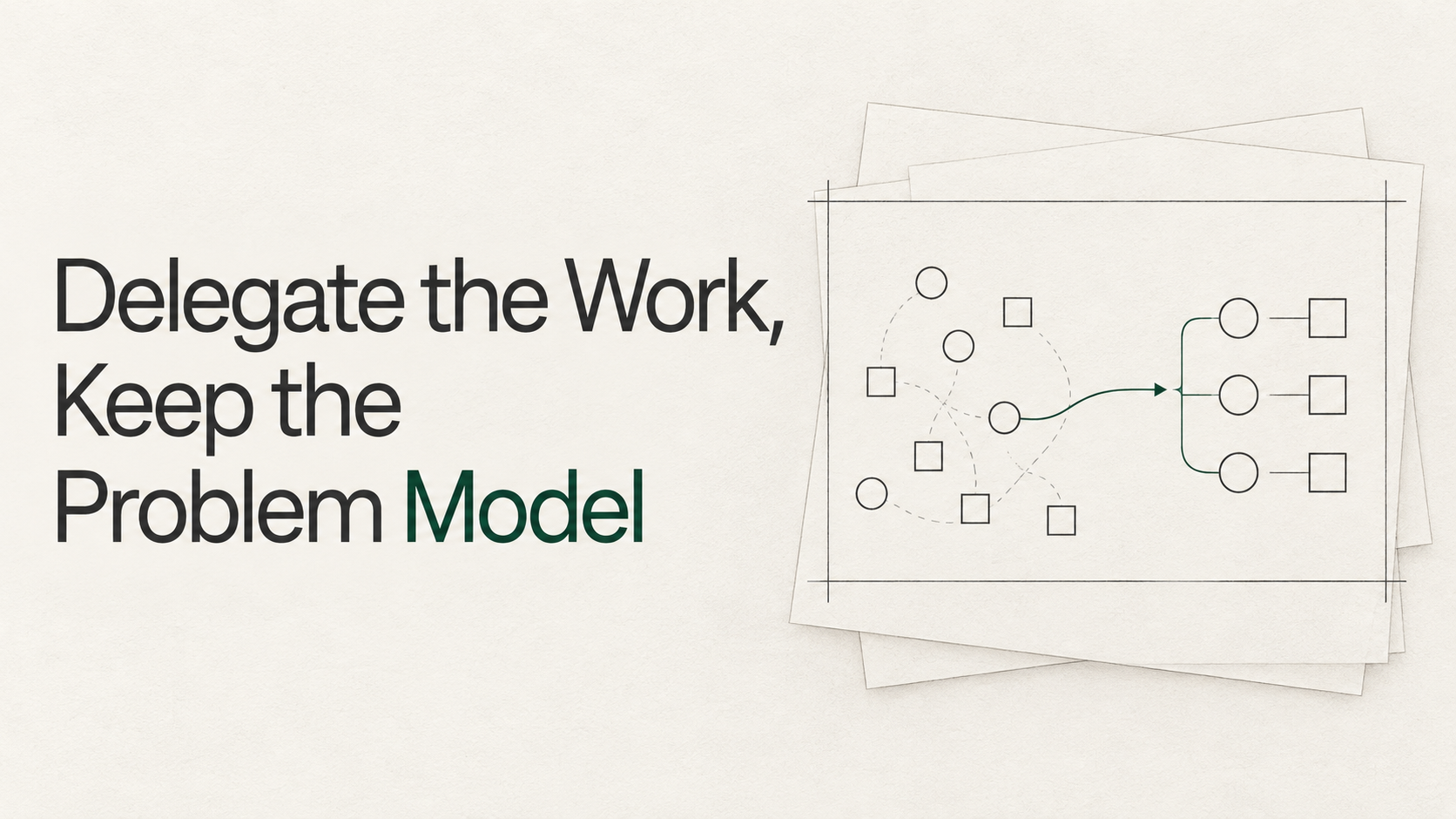
Imagine a hypothetical task: asking an assistant to restructure a loose set of activity records into a summary table. The generated script runs cleanly, producing a tidy table where the overall counts match expectations. Yet a critical question can easily go unexamined: what is one row supposed to represent, and what distinctions need to remain visible? If the transformation quietly rolls refunded orders into completed sales, or collapses distinct interaction types into a single aggregate, the total count remains mathematically correct while concealing an essential distinction. The output looks orderly, but the underlying meaning has shifted. Without an explicit sense of what the restructuring must preserve, a clean table can easily be mistaken for an accurate representation.
For me, this highlights where the practical boundary in AI delegation lies: what matters most is whether I can still name and question what a good result must preserve, rather than carrying out every mechanical step myself. Handing over transformations does not mean relinquishing judgment. I do not have to memorize every implementation detail, especially when written notes and AI explanations can support my understanding along the way. What I need to protect is a coherent sense of the boundaries, the conditions that cannot be broken, and the unresolved choices that still require consideration.
Holding that problem model does not guarantee correctness, nor is it a rigid blueprint. My initial framing can easily be mistaken, incomplete, or based on flawed assumptions. When an assistant generates an alternative structure or highlights inconsistencies in how I defined the problem, it may suggest a better interpretation than the one I started with. The purpose of maintaining a model is not to defend a starting guess, but to provide a clear enough reference point so that I can recognize when the assistant has surfaced a more sensible way to organize the data.
Research hints at some of the trade-offs in automated assistance, though the findings come with important caveats. In a study of engineers learning a programming library, those using AI assistance had lower immediate quiz averages, but that difference does not establish long-term skill loss. Similarly, a survey of knowledge workers found that higher confidence in generative tools correlated with lower self-reported critical thinking, yet self-reports do not demonstrate a causal decline in ability. Neither study suggests that cognitive atrophy is inevitable, nor do they validate this particular approach to working with data.
On my next data task, I intend to keep a rough model of the goal, the invariants that must hold true, and the choices I have not yet settled. I will let Codex carry out the transformations, and then explain to myself why the resulting output fits the problem, remaining open to revising my own framing if the work reveals a better perspective. This is simply an untested personal intention rather than a proven method; my aim is to keep my attention on what the data must mean while delegating the mechanics of reshaping it.